INVESTOR & PRODUCT PRESENTATION · 22 OCTOBER 2026
Seed State OS.
The product and its evidence.
Benefits, recorded results and the proposed licensing route. Each comparison keeps its workload and measurement boundary.
UK patent application GB2624953.2 · Pending
Slide 1 of 12
Use the arrow buttons or focus the presentation and press the left or right arrow key. The PDF includes all 12 slides. Read the full text below.
ACCESSIBLE TEXT VERSION
Read the presentation.
Recorded studies support scoped evaluations. Production delivery and commercial terms require agreement.
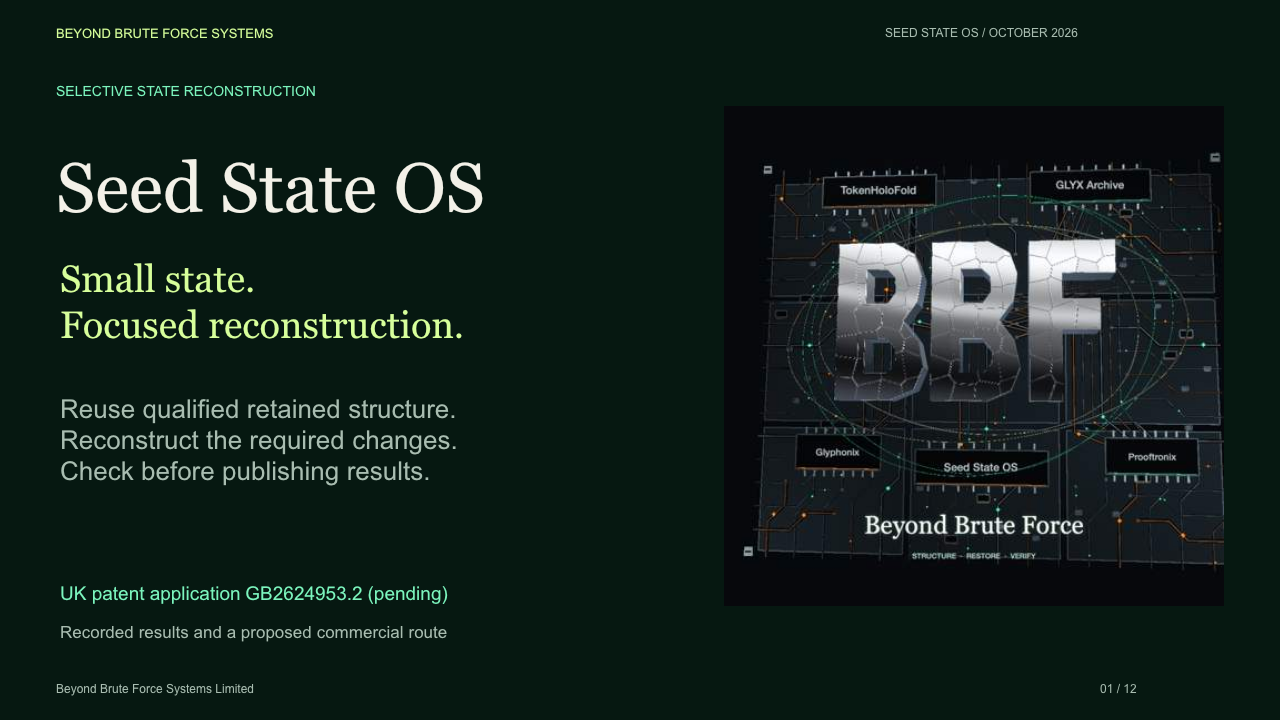
01. Seed State OS
UK patent application GB2624953.2 (pending). Recorded results and a proposed commercial route.
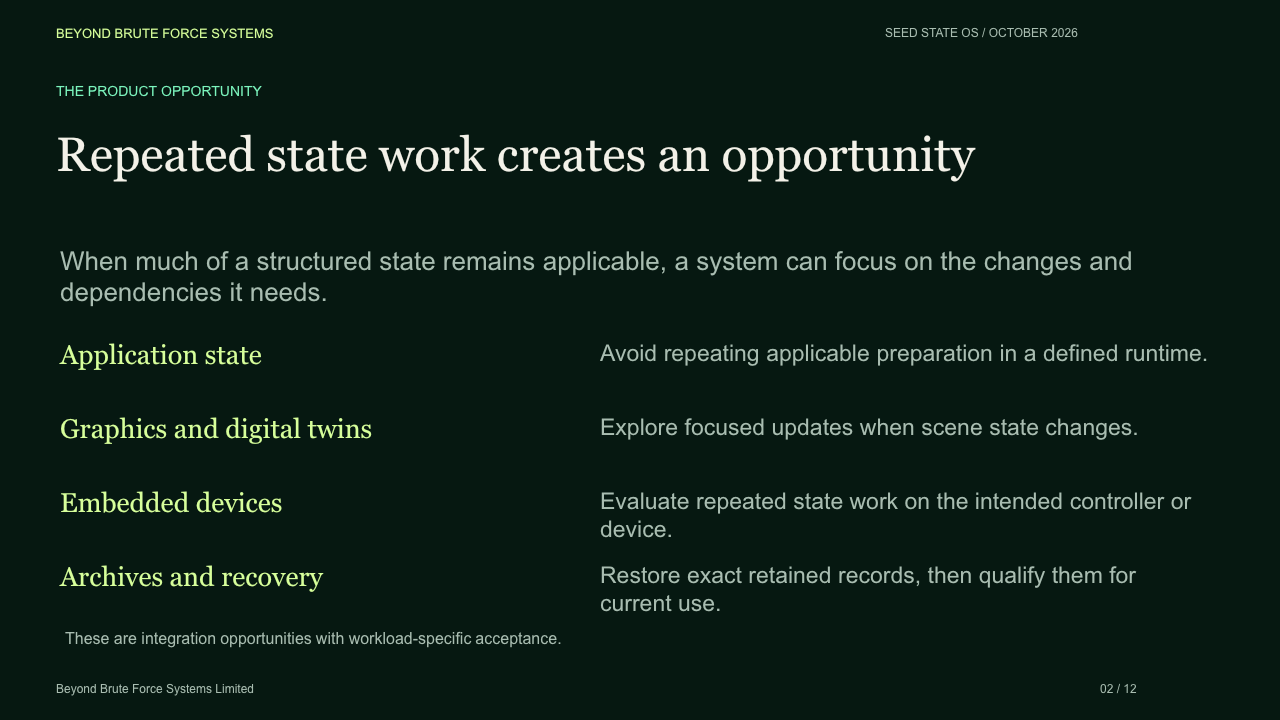
02. Repeated state work creates an opportunity
When much of a structured state remains applicable, a system can focus on the changes and dependencies it needs.
Application state
Avoid repeating applicable preparation in a defined runtime.
Graphics and digital twins
Explore focused updates when scene state changes.
Embedded devices
Evaluate repeated state work on the intended controller or device.
Archives and recovery
Restore exact retained records, then qualify them for current use.
These are integration opportunities with workload-specific acceptance.
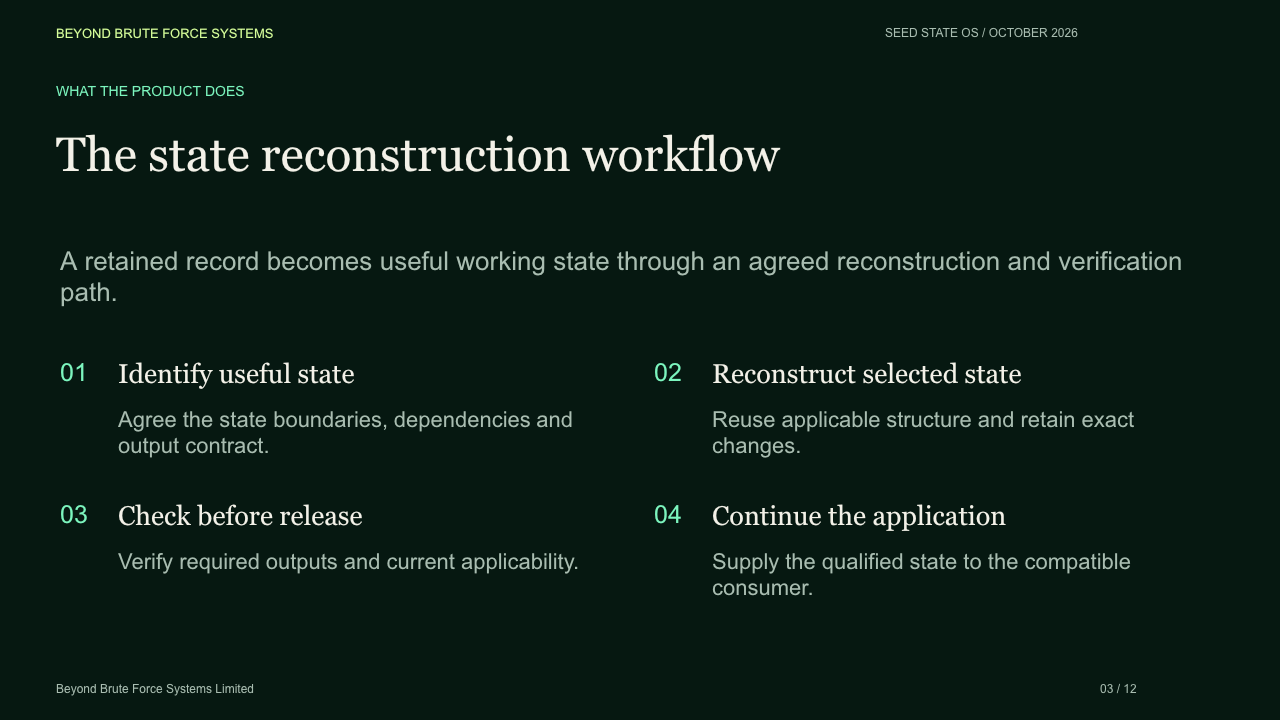
03. The state reconstruction workflow
A retained record becomes useful working state through an agreed reconstruction and verification path.
Identify useful state
Agree the state boundaries, dependencies and output contract.
Reconstruct selected state
Reuse applicable structure and retain exact changes.
Check before release
Verify required outputs and current applicability.
Continue the application
Supply the qualified state to the compatible consumer.
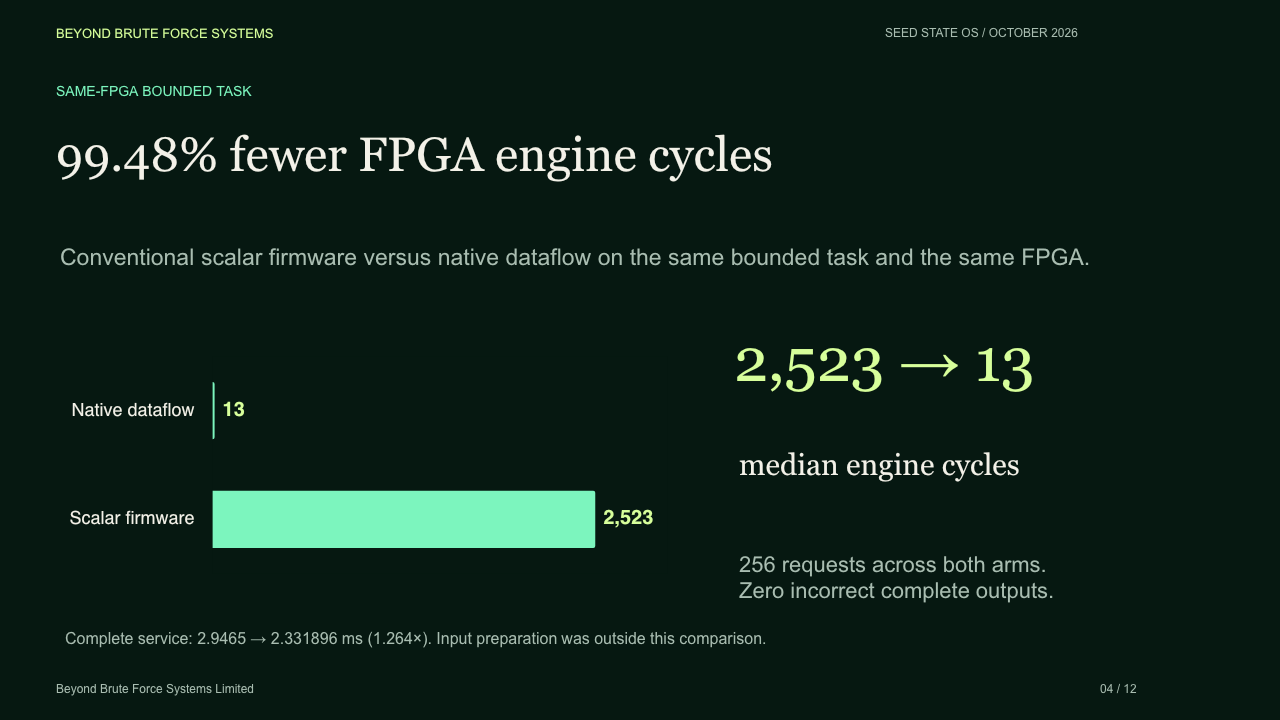
04. 99.48% fewer FPGA engine cycles
Conventional scalar firmware versus native dataflow on the same bounded task and the same FPGA.
2,523 → 13
median engine cycles
256 requests across both arms.
Zero incorrect complete outputs.
| Scalar firmware | 2523 |
|---|---|
| Native dataflow | 13 |
Complete service: 2.9465 → 2.331896 ms (1.264×). Input preparation was outside this comparison.
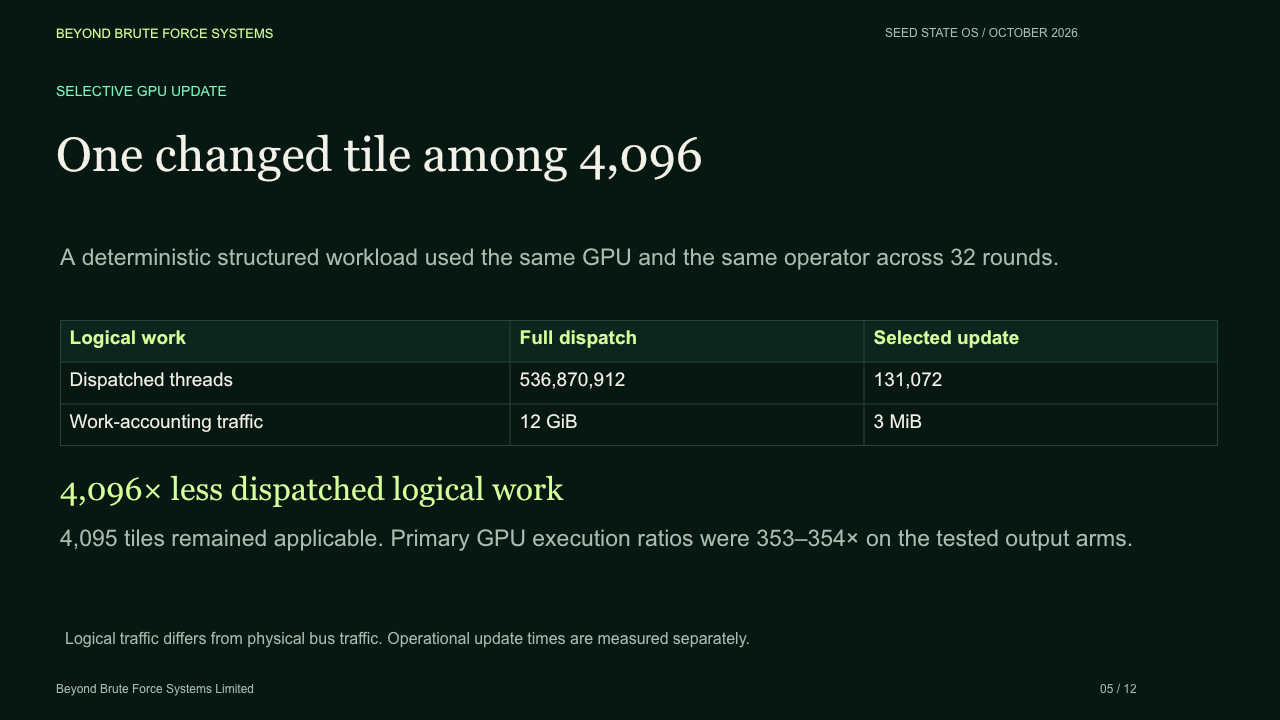
05. One changed tile among 4,096
A deterministic structured workload used the same GPU and the same operator across 32 rounds.
| Logical work | Full dispatch | Selected update |
|---|---|---|
| Dispatched threads | 536,870,912 | 131,072 |
| Work-accounting traffic | 12 GiB | 3 MiB |
4,096× less dispatched logical work
4,095 tiles remained applicable. Primary GPU execution ratios were 353–354× on the tested output arms.
Logical traffic differs from physical bus traffic. Operational update times are measured separately.
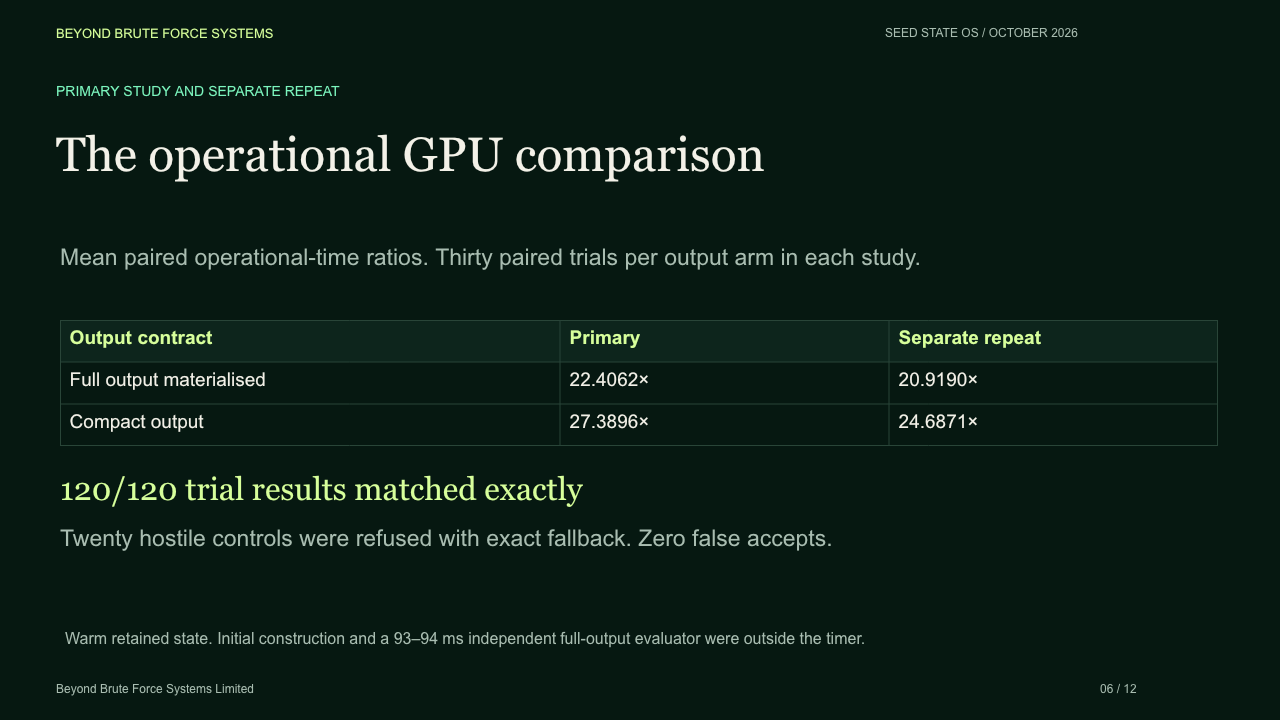
06. The operational GPU comparison
Mean paired operational-time ratios. Thirty paired trials per output arm in each study.
| Output contract | Primary | Separate repeat |
|---|---|---|
| Full output materialised | 22.4062× | 20.9190× |
| Compact output | 27.3896× | 24.6871× |
120/120 trial results matched exactly
Twenty hostile controls were refused with exact fallback. Zero false accepts.
Warm retained state. Initial construction and a 93–94 ms independent full-output evaluator were outside the timer.
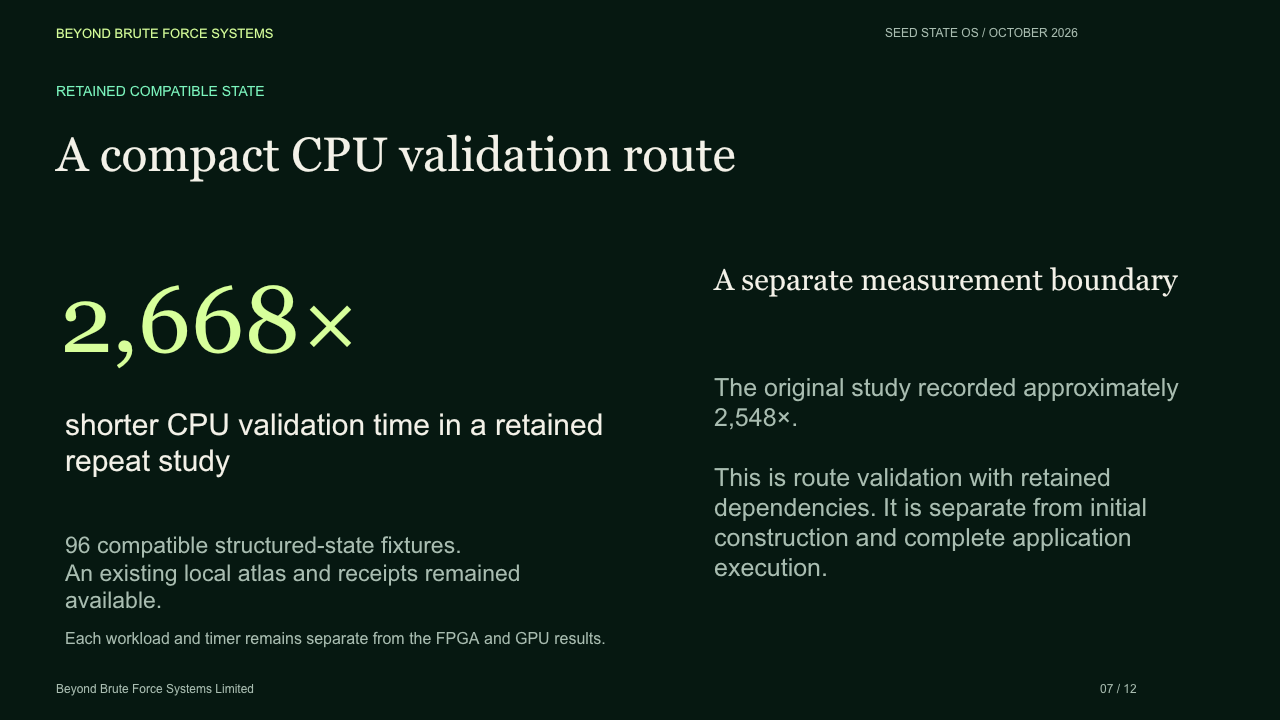
07. A compact CPU validation route
2,668×
shorter CPU validation time in a retained repeat study
96 compatible structured-state fixtures.
An existing local atlas and receipts remained available.
A separate measurement boundary
The original study recorded approximately 2,548×.
This is route validation with retained dependencies. It is separate from initial construction and complete application execution.
Each workload and timer remains separate from the FPGA and GPU results.
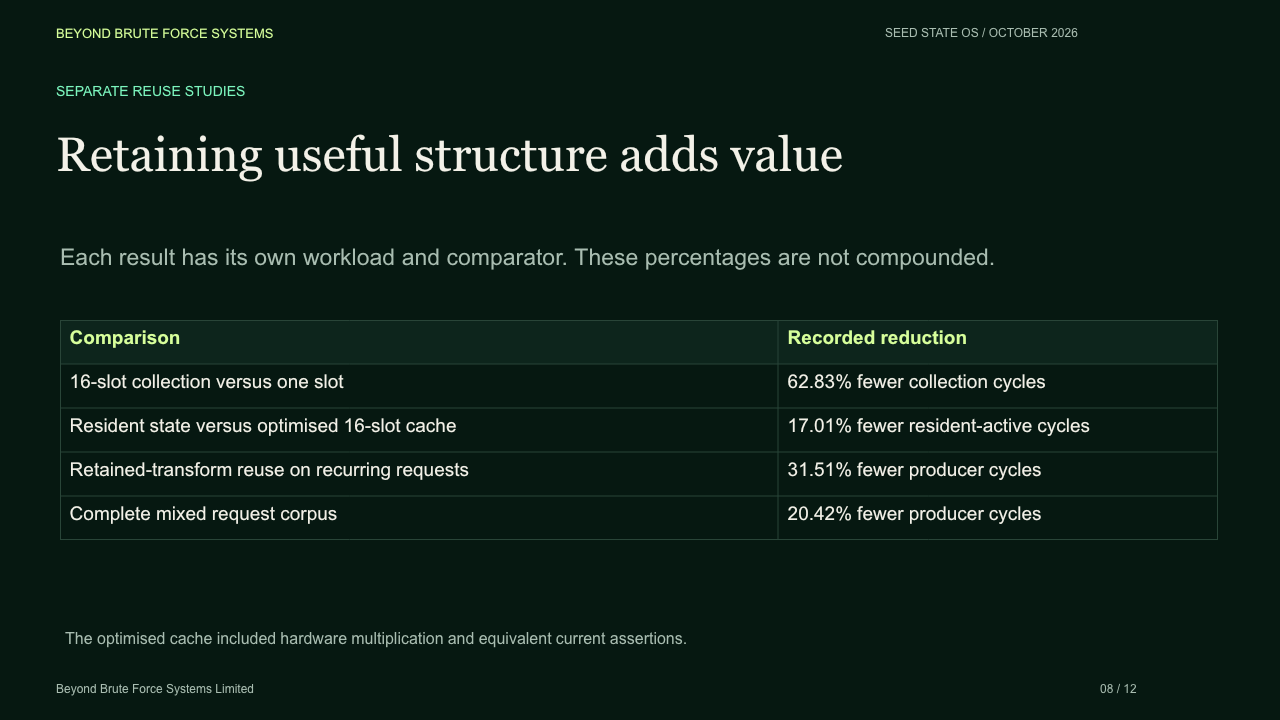
08. Retaining useful structure adds value
Each result has its own workload and comparator. These percentages are not compounded.
| Comparison | Recorded reduction |
|---|---|
| 16-slot collection versus one slot | 62.83% fewer collection cycles |
| Resident state versus optimised 16-slot cache | 17.01% fewer resident-active cycles |
| Retained-transform reuse on recurring requests | 31.51% fewer producer cycles |
| Complete mixed request corpus | 20.42% fewer producer cycles |
The optimised cache included hardware multiplication and equivalent current assertions.
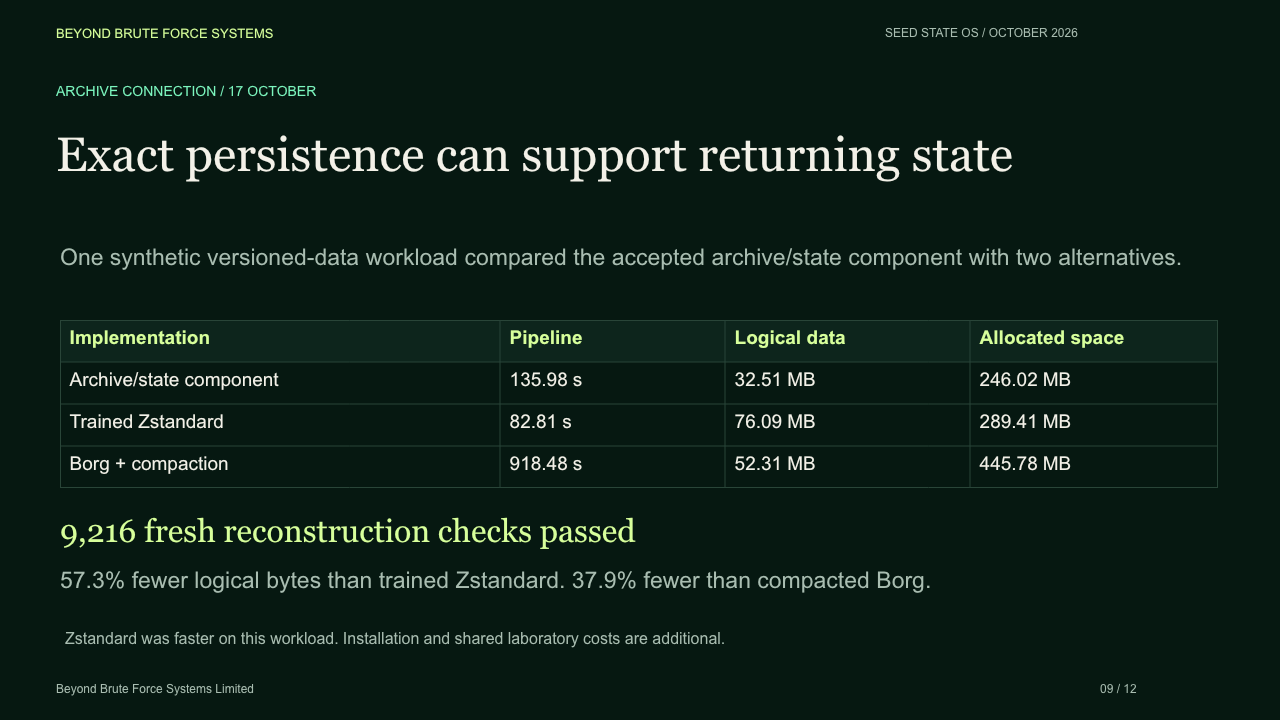
09. Exact persistence can support returning state
One synthetic versioned-data workload compared the accepted archive/state component with two alternatives.
| Implementation | Pipeline | Logical data | Allocated space |
|---|---|---|---|
| Archive/state component | 135.98 s | 32.51 MB | 246.02 MB |
| Trained Zstandard | 82.81 s | 76.09 MB | 289.41 MB |
| Borg + compaction | 918.48 s | 52.31 MB | 445.78 MB |
9,216 fresh reconstruction checks passed
57.3% fewer logical bytes than trained Zstandard. 37.9% fewer than compacted Borg.
Zstandard was faster on this workload. Installation and shared laboratory costs are additional.
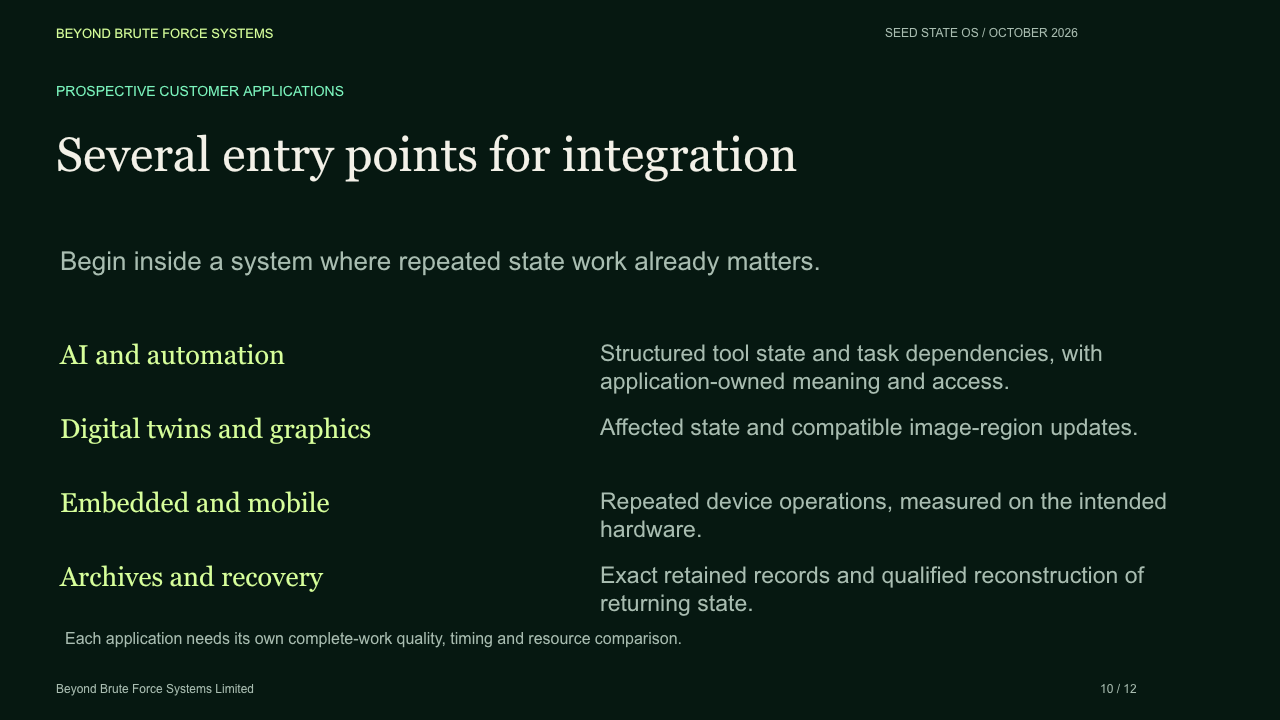
10. Several entry points for integration
Begin inside a system where repeated state work already matters.
AI and automation
Structured tool state and task dependencies, with application-owned meaning and access.
Digital twins and graphics
Affected state and compatible image-region updates.
Embedded and mobile
Repeated device operations, measured on the intended hardware.
Archives and recovery
Exact retained records and qualified reconstruction of returning state.
Each application needs its own complete-work quality, timing and resource comparison.
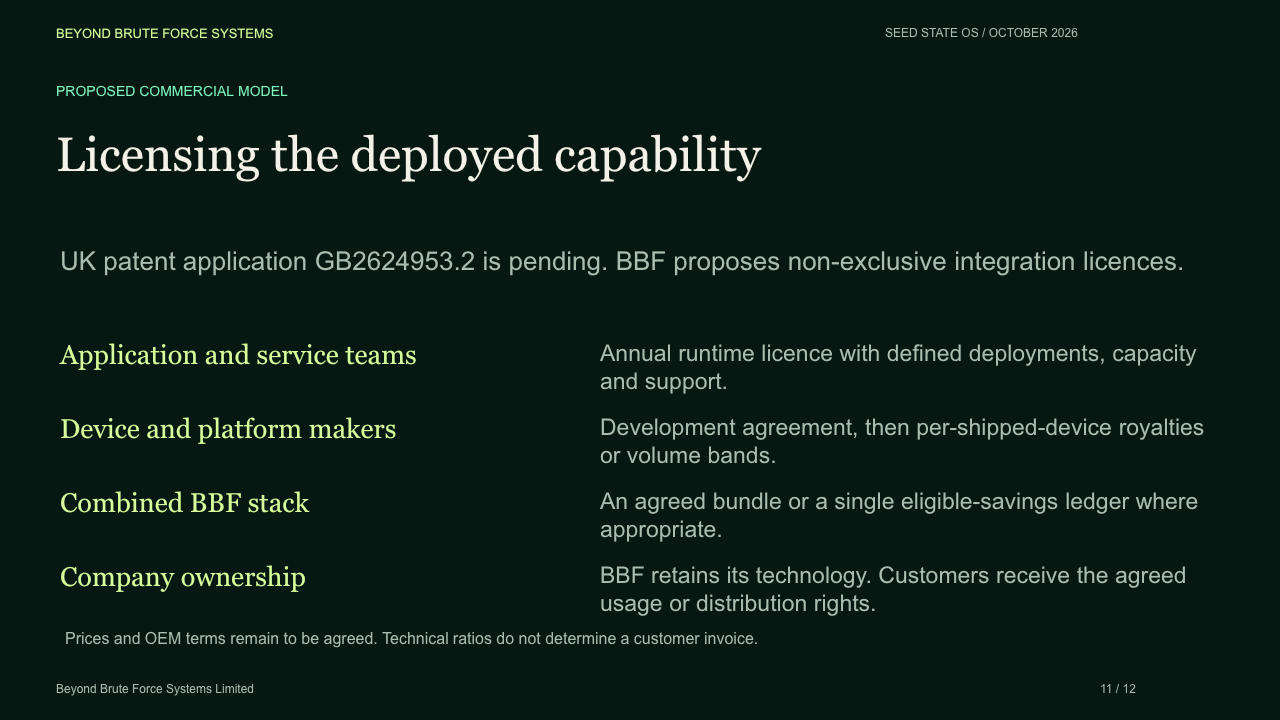
11. Licensing the deployed capability
UK patent application GB2624953.2 is pending. BBF proposes non-exclusive integration licences.
Application and service teams
Annual runtime licence with defined deployments, capacity and support.
Device and platform makers
Development agreement, then per-shipped-device royalties or volume bands.
Combined BBF stack
An agreed bundle or a single eligible-savings ledger where appropriate.
Company ownership
BBF retains its technology. Customers receive the agreed usage or distribution rights.
Prices and OEM terms remain to be agreed. Technical ratios do not determine a customer invoice.
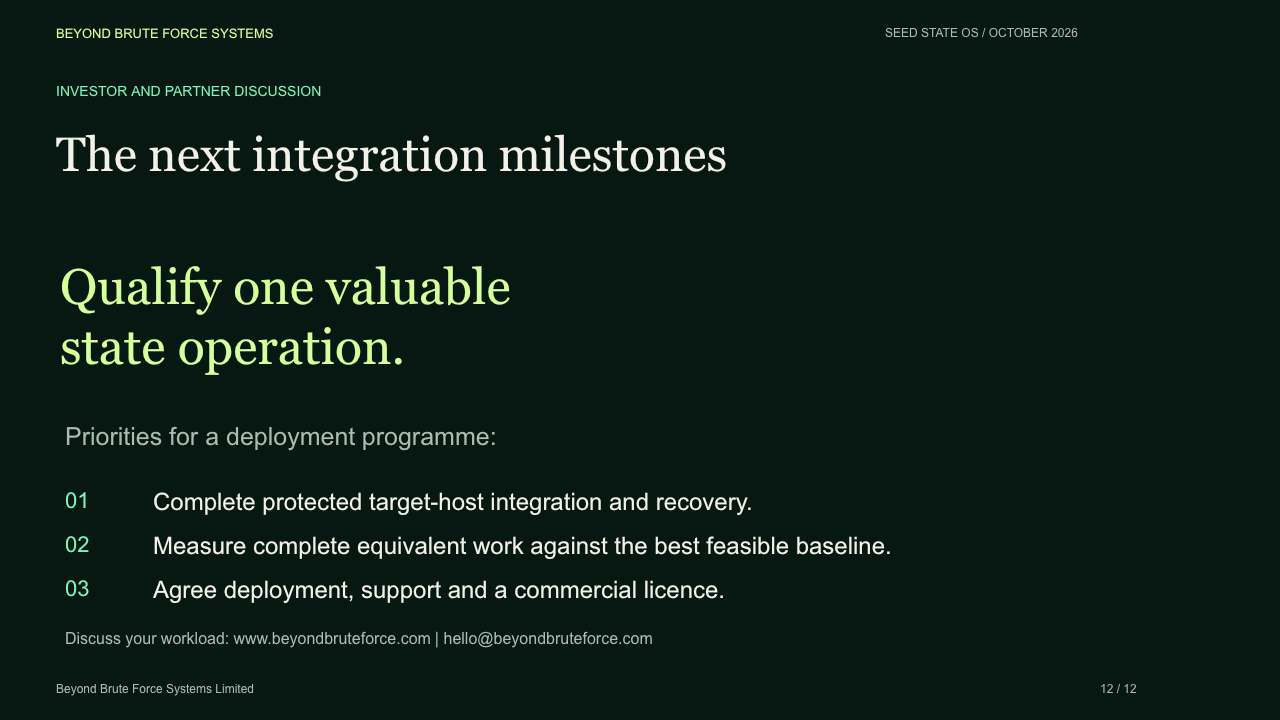
12. The next integration milestones
Qualify one valuable
state operation.
Priorities for a deployment programme:
01
Complete protected target-host integration and recovery.
02
Measure complete equivalent work against the best feasible baseline.
03
Agree deployment, support and a commercial licence.
Discuss your workload: www.beyondbruteforce.com | hello@beyondbruteforce.com
UK patent application GB2624953.2 is pending. Read the evidence and comparison boundaries →